Bitcoin Closes February Just 9% Below All-Time High, Breaking $60,000
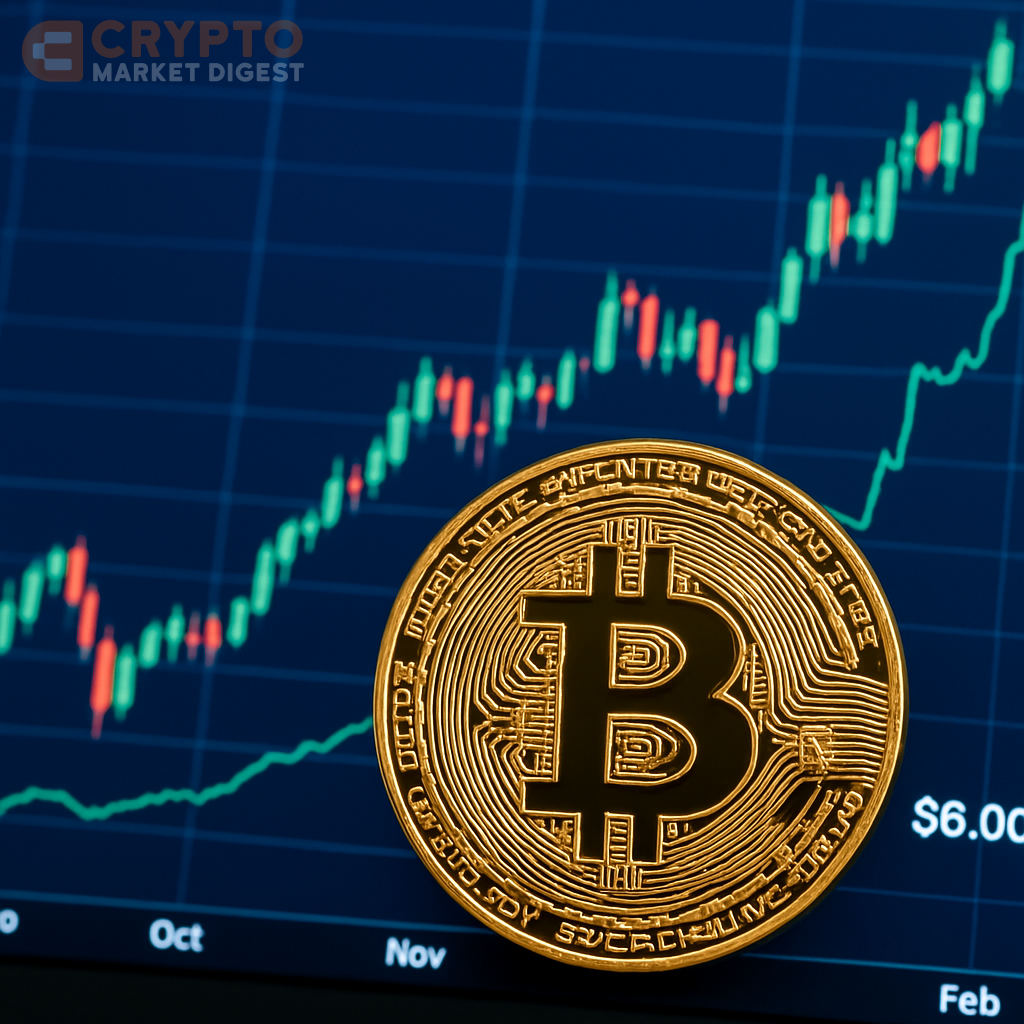
Bitcoin ended February on a high note, closing the month at over $60,000 and sitting just 9% below its all-time high, marking a significant milestone in what has been a remarkable recovery for the world’s leading cryptocurrency.
Bitcoin’s Impressive February Rally
After starting the month around $43,000, Bitcoin staged an impressive rally throughout February, gaining over 40% in value to close above the psychologically important $60,000 threshold. The last time Bitcoin consistently traded above this level was in November 2021, when it reached its all-time high of approximately $69,000.
Market analysts attribute this surge to several factors, including increased institutional adoption, the successful launch of spot Bitcoin ETFs in the United States, and improving macroeconomic conditions.
“What we’re seeing is the convergence of multiple positive catalysts that have been building for months,” said Sarah Johnson, Chief Crypto Strategist at Digital Asset Research. “The approval of spot Bitcoin ETFs in January was just the beginning. Now we’re witnessing the follow-through as these investment vehicles attract billions in inflows.”
Indeed, the recently approved spot Bitcoin ETFs have collectively accumulated over $10 billion in assets under management since their launch in January, exceeding many analysts’ expectations and providing a steady source of demand for Bitcoin.
Institutional Adoption Accelerates
A key driver behind Bitcoin’s resurgence has been the growing acceptance of cryptocurrencies by mainstream financial institutions. Several major banks and asset managers have expanded their crypto offerings in recent months, providing more avenues for traditional investors to gain exposure to digital assets.
BlackRock, the world’s largest asset manager, has been particularly active in the space with its iShares Bitcoin Trust (IBIT) attracting substantial inflows. Fidelity, Bitwise, and other financial heavyweights have also seen strong demand for their Bitcoin investment products.
Michael Stevens, portfolio manager at Granite Investment Partners, explained, “Institutional involvement has matured significantly. We’re no longer just talking about speculative interest. Major players are establishing long-term positions based on Bitcoin’s potential as a store of value and inflation hedge.”
Corporate treasuries have also continued to accumulate Bitcoin. MicroStrategy, led by Bitcoin advocate Michael Saylor, added to its substantial holdings in February, purchasing an additional 2,500 Bitcoin for approximately $115 million.
“We believe Bitcoin is the most efficient way to store value across time and space,” Saylor said during a recent earnings call. “Our strategy to acquire and hold Bitcoin has served our shareholders well, and we intend to continue this approach.”
Factors Behind the Rally
Several other factors have contributed to Bitcoin’s impressive performance in February:
Global Economic Uncertainty
Persistent inflation concerns and geopolitical tensions have prompted investors to seek alternative assets. Bitcoin, with its fixed supply of 21 million coins, has increasingly been viewed as a hedge against currency devaluation.
James Wilson, economist at Global Financial Insights, noted, “Central banks continue to grapple with inflation, and the ongoing conflicts in various regions create unpredictability. In such environments, Bitcoin’s mathematical certainty becomes attractive to a growing segment of investors.”
Technical Developments
The Bitcoin network continues to demonstrate remarkable resilience and growing utility. The Lightning Network, a layer-2 solution designed to make Bitcoin transactions faster and cheaper, has seen steady growth in capacity and adoption.
“What’s often overlooked is how Bitcoin’s technical infrastructure continues to improve,” said Alex Rodriguez, CTO of Blockchain Solutions Inc. “The Lightning Network now enables millions of near-instant, low-cost transactions, addressing one of the main criticisms of Bitcoin as a payment system.”
Regulatory Clarity
While regulatory challenges remain, there has been gradual improvement in regulatory clarity in several key markets. The approval of spot Bitcoin ETFs in the United States was seen as a significant regulatory milestone.
“The SEC’s approval of spot Bitcoin ETFs, even if reluctant, signaled a new phase in Bitcoin’s regulatory journey,” commented Rebecca Chen, partner at Crypto Legal Advisors. “This gives institutional investors more confidence to enter the market, knowing that regulators are establishing frameworks rather than seeking to ban cryptocurrency outright.”
Market Sentiment and Retail Interest
The price surge has reignited interest among retail investors, many of whom had stepped back from crypto markets during the prolonged bear market of 2022 and early 2023.
Google search trends for “Bitcoin” and related terms have increased substantially in February, though they remain below the peak levels seen during previous bull runs. This suggests that while retail interest is growing, the current rally has been driven more by institutional money than by retail speculation.
Social media activity around Bitcoin has also picked up, with Twitter (now X) mentions of Bitcoin nearly doubling in February compared to January.
Thomas Green, a social media analyst who tracks crypto trends, observed, “The tone of conversations has shifted markedly. In 2022 and much of 2023, the discourse was dominated by skepticism and discussions of various collapses in the crypto space. Now, we’re seeing more forward-looking conversations about adoption and price potential.”
Comparisons to Previous Cycles
Market veterans are drawing parallels and noting differences between the current market conditions and previous Bitcoin bull cycles.
“This rally feels different from 2017 or even 2021,” said David Park, who has been trading cryptocurrencies since 2013. “There’s less FOMO (fear of missing out) and hype, but more substantial infrastructure and institutional involvement. The market seems more mature.”
Others point to Bitcoin’s four-year cycle, often correlated with its halving events. The next Bitcoin halving, which will reduce the reward for mining new blocks by 50%, is expected in April 2024.
“Historically, Bitcoin tends to perform strongly in the 12-18 months following a halving,” explained Maria Santos, author of “Cryptocurrency Cycles.” “If this pattern holds, the current move could be just the beginning of a larger uptrend that might extend into 2025.”
Challenges and Risks Ahead
Despite the bullish momentum, analysts caution that several factors could disrupt Bitcoin’s trajectory:
Regulatory Developments
While there has been progress on the regulatory front, Bitcoin and cryptocurrencies broadly still face regulatory uncertainty in many jurisdictions. Any adverse regulatory developments could impact market sentiment.
“Regulation remains a double-edged sword,” said Robert Keller, former financial regulator and crypto consultant. “While clearer frameworks can foster adoption, overly restrictive measures could stifle innovation and market growth.”
Macroeconomic Conditions
Bitcoin’s performance has shown sensitivity to broader macroeconomic factors, particularly Federal Reserve policy and interest rates. Any shifts in monetary policy could affect Bitcoin’s appeal as an inflation hedge.
“If the Fed pivots to more aggressive rate cuts, it could further fuel Bitcoin’s rise,” said economic analyst Jennifer Wu. “Conversely, if inflation proves more persistent than expected and rates remain elevated, we might see pressure on risk assets including Bitcoin.”
Technical Corrections
After such a rapid appreciation, some technical analysts believe a correction is inevitable. Bitcoin’s volatile history includes numerous 20-30% drawdowns even during broader bull markets.
“The path upward is never straight,” cautioned technical analyst Mark Williams. “Investors should be prepared for significant volatility. A pullback to test support in the $50,000-$55,000 range wouldn’t be unusual or concerning from a technical perspective.”
Looking Ahead
As Bitcoin closes February near the $60,000 mark, just 9% below its all-time high, the market outlook remains cautiously optimistic. The approaching halving event, continued institutional adoption, and evolving narrative around Bitcoin’s role in the global financial system provide potential catalysts for further appreciation.
However, market participants emphasize the importance of maintaining realistic expectations and preparing for volatility.
“Bitcoin has demonstrated remarkable resilience over its 15-year history,” concluded financial historian Patricia Moore. “Its journey from a niche internet experiment to an asset class attracting the world’s largest financial institutions is unprecedented. But that journey has never been smooth, and likely never will be.”
For now, Bitcoin’s strong February performance has reinforced confidence among long-term holders and attracted fresh interest from investors who had previously remained on the sidelines. Whether this momentum can carry Bitcoin to new all-time highs in the coming months remains to be seen, but the foundation for such a move appears stronger than in previous cycles.
As traditional markets continue to navigate uncertain economic conditions, Bitcoin’s performance through the remainder of 2024 will likely provide further insights into its evolving role within the global financial ecosystem.
Stay ahead of market moves!
Beat the crowd to every crypto opportunity with our exclusive, free newsletter delivered daily to your inbox.
By subscribing, you agree to Crypto Market Digest's Terms and Privacy Policy.
Disclaimer:
The information provided on this blog is for informational and educational purposes only and does not constitute financial, investment, legal, or other professional advice. Cryptocurrency investments are highly volatile and carry significant risk. Always conduct your own research and consult with a qualified financial advisor before making any investment decisions. We do not endorse or guarantee the accuracy or completeness of any third-party content linked or referenced on this site. By using this blog, you agree that the authors and publishers are not responsible for any losses or damages resulting from your reliance on the information provided.